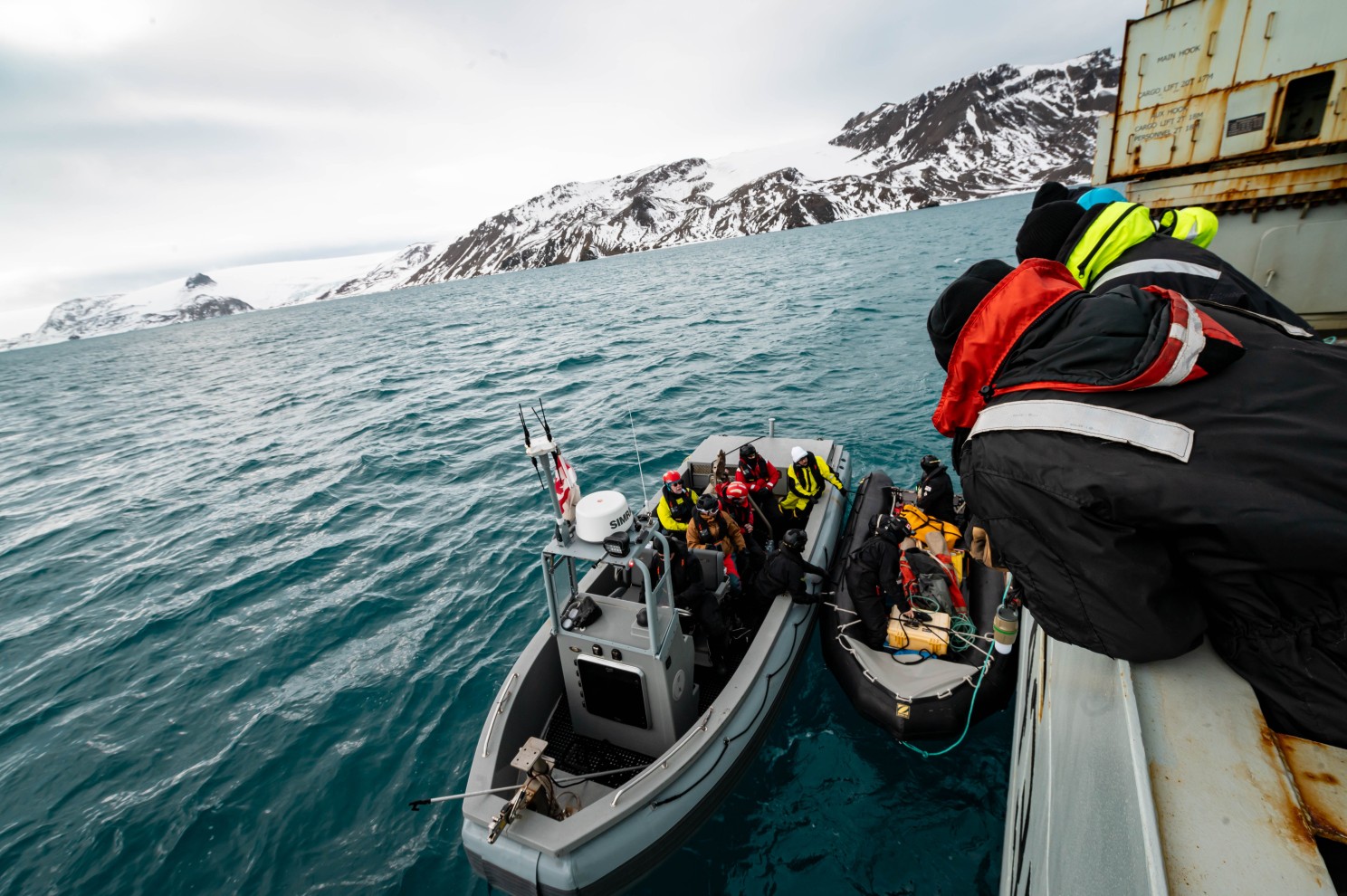
On the record-setting expedition of a Canadian naval vessel into Antarctic waters, a cross-country collaborative research effort will further Canada’s scientific understanding of polar waters and climate.
Dr. Sophia Johannessen, from Fisheries and Oceans Canada / Pêches et Océans Canada (DFO), joins a team of Canadian scientists headed to the Antarctic aboard the Canadian Naval vessel, HMCS Margaret Brooke. The team is set to conduct first of its kind research into furthering Canadian understanding of polar waters.
“This is an amazing opportunity, and I am excited to have a chance to go. The Southern Ocean, which encircles Antarctica, plays a critical role in regulating the Earth’s climate,” said Dr. Johannessen.
The research team onboard the Margaret Brooke brings together scientists from five universities across Canada, coordinated by MEOPAR: Marine Environmental Observation, Prediction and Response Network, as well as scientists from three government departments, Natural Resources Canada (NRCan), Environment and Climate Change Canada(ECCC), and DFO). Alongside supporting the expedition scientists, NRCan, DFO, and MEOPAR have provided essential equipment to support the scientists’ research efforts in Antarctica and aboard the vessel.
Dr. Johannessen brings unique expertise as a geochemical oceanographer with a keen interest in studying sediment core records. She utilizes sediment cores to gain a greater understanding of ocean waters.
Dr. Johannessen is looking forward to all of the unique opportunities that this expedition will afford: working on a navy ship, working together with a collaborative group of scientists from across Canada, visiting Antarctic research bases, meeting scientists from other countries, and learning more about the oceans and around Antarctica.
“I wanted to do it to contribute a tiny piece to the oceanographic understanding of this fascinating place.”
Dr. Johannessen’s research interests range from light and underwater weather at the top of the ocean to the burial and reworking of sediments at the bottom. Although she mainly works in the coastal waters of British Columbia, Dr. Johannessen has also worked in the Arctic, Atlantic and open Pacific.
Dr. Johannessen has an impressive record with extensive experience both at home and abroad. She was an invited keynote speaker at the opening plenary session of the Estuarine and Coastal Science Association international conference in Hangzhou, China, this past September and has published over 50 research papers in international scientific journals.
Coupled with her academic accomplishments, Dr. Johannessen possesses expertise in several research areas, including the effects of climate change on coastal waters, blue carbon, oxygen dynamics and hypoxia, underwater weather (sinking particles), plus her personal favourite, history in the mud (sediment cores).
Through her interest in core sediment research, Dr. Johannessen can understand aspects of the ocean waters she studies, and Antarctica provides an ideal area for much-needed research.
Here is a brief explanation of her unique research approach in her own words:
“A rain of particles falls through the ocean, but it is not always the same at every time or in every place. There is a kind of weather underwater. Rainstorms or spring meltwater carry tiny particles of ground-up rock, leaves and soil off land into the ocean. Blooms of phytoplankton, zooplankton and jellyfish result in a blizzard of marine particles.
“The particles accumulate in the sediment (mud) at the bottom of the ocean, newer particles on top of older ones, building up a history. Then we go and collect cores – vertical tubes of mud about 50 cm long – cut them up into small layers, send them off for analysis and read that history.
Dr. Johannessen does both basic and applied research. Applied research questions are the ones that most people find interesting, such as ‘Could a decline in phytoplankton growth over the last 30 years in the Salish Sea explain the decline in salmon?’ or ‘How much could seagrass meadow blue carbon contribute to climate change mitigation?’
But to give good answers to those questions, it’s important to do basic work first. That basic work takes years or even decades to carry out, but once completed, scientists can have confidence in their answers to the more outwardly exciting short-term, applied research questions.
“Every core is different. Each one tells its own story.”
To learn more about Dr. Johannessen’s research and follow the expedition in Antarctica, subscribe to NRCan Science, Fisheries and Oceans Canada / Pêches et Océans Canada and MEOPAR on LinkedIn.