Kelp forests are some of the ocean’s most productive and valuable ecosystems. They shelter marine life, support fisheries, and lock away carbon. Yet they’re vanishing fast, with climate change as the biggest threat. Our communication specialist, Rosie Poirier, joined a team of divers studying and restoring kelp forests. With her camera in hand, she followed the team as they used support from MEOPAR’s Knowledge Mobilization Fund to create immersive 360° underwater videos showcasing their work to the public.
After a four-hour drive from Victoria, Rosie arrived at the Bamfield Marine Sciences Centre (BMSC), located on the traditional territory of the Huu-ay-aht First Nations on the outer west coast of Vancouver Island. There, she met with the Kelp Rescue Initiative team, a BMSC program dedicated to researching, protecting, and restoring declining kelp forests across British Columbia (BC).
“We all knew we were losing kelp forests on our coastline here in BC and everybody wanted to do something about it. […] So, we started the Kelp Rescue Initiative with the purpose of finding science-backed solutions to enhance and restore our kelp forests”, explained Brian Timmer, a researcher from the non-profit organization.
Less than two hours after arriving, Rosie was already aboard a boat with the team. The crisp late-October air was a reminder that winter was approaching. BMSC Diving Safety Officer Hannah Schriber briefed the team before their check-out dive.
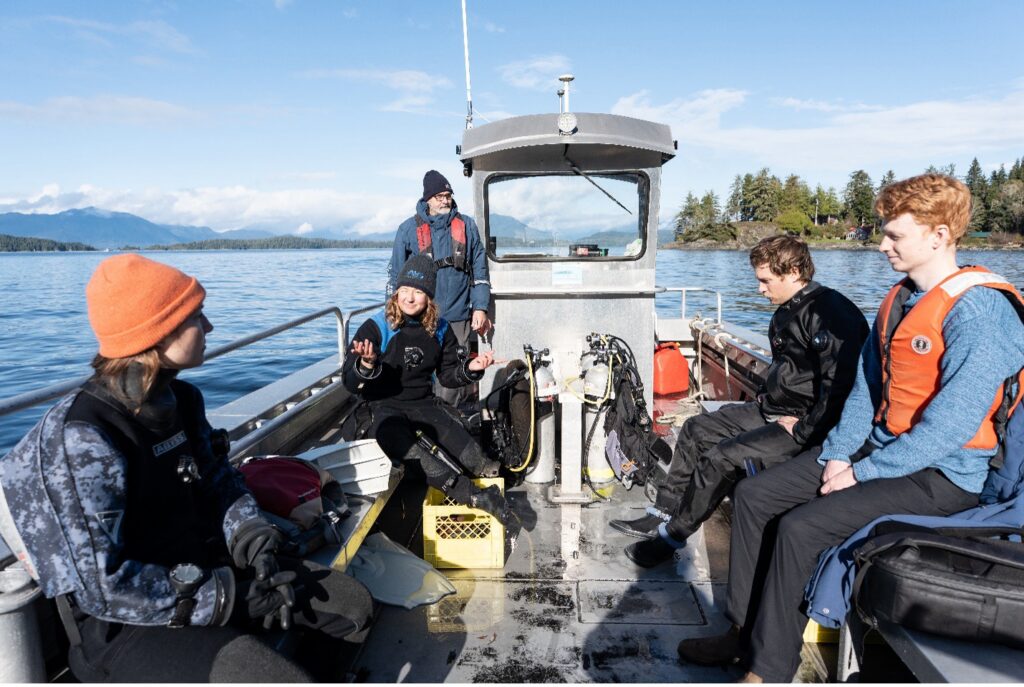
All photos by Rosie Poirier
Jasmin Shuster, lead of the project on Virtual Kelp Forests, which features immersive 360° underwater videos captured during this multi-day field trip, successfully completed her assessment dive.
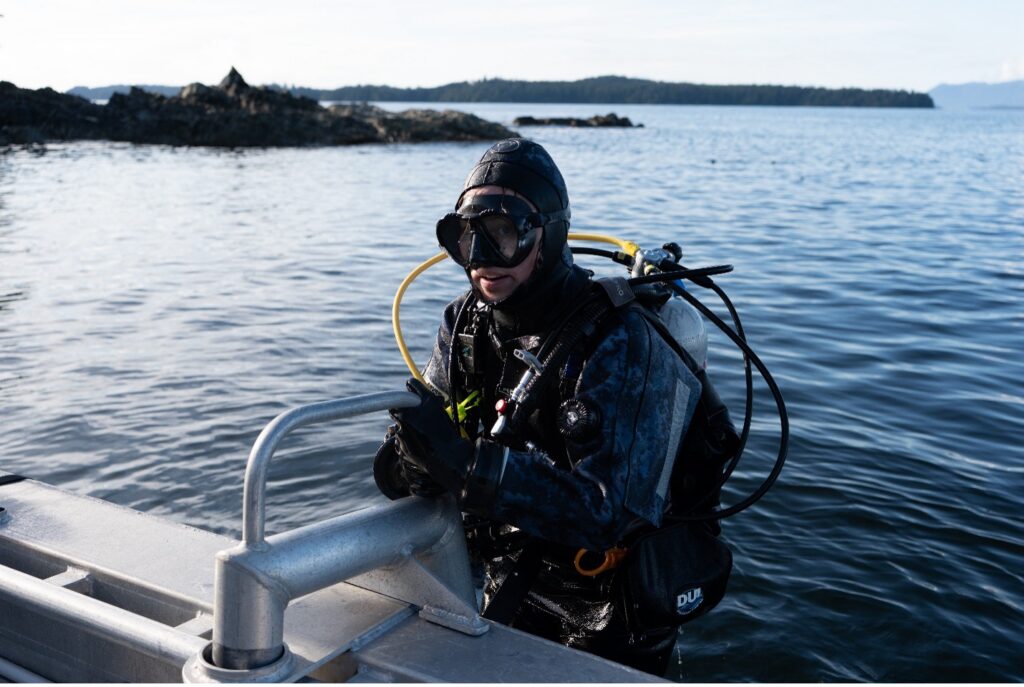
Although the first day was a success, rough weather over the following two days kept the team on land. A good opportunity for Rosie to learn more about kelp forests.
KELP FORESTS: DISTRIBUTION, COMPOSITION, AND BIODIVERSITY
• Appearance: underwater forests of large brown seaweeds forming a dense, moving canopy.
• Distribution (worldwide): Kelp forests cover around 30% of the world’s coastlines.
• Distribution (Canada): Kelp forests occur along Canada’s Pacific, Atlantic, and Arctic coasts. In the Pacific, kelp can reach the surface, while in the Atlantic and Arctic, it typically grows near the seafloor.
• Species: Kelp forests in British Columbia can be formed by several kelp species, including giant kelp (Macrocystis pyrifera), bull kelp (Nereocystis luetkeana), and sugar kelp (Saccharina latissima).
• Fast-growing: Giant kelp can grow up to 30–60 cm per day and reach more than 30 metres in length.
• Biodiversity hotspots: Kelp forests provide habitat for thousands of species, from microscopic invertebrates to whales that forage around the kelp canopy.
SOURCES: Eger et al. 2024, One Earth; Edwards 2025, Annual Review of Ecology, Evolution, and Systematics; McHenry et al, 2025, npj Ocean Sustainability
Making the most of a day in the field
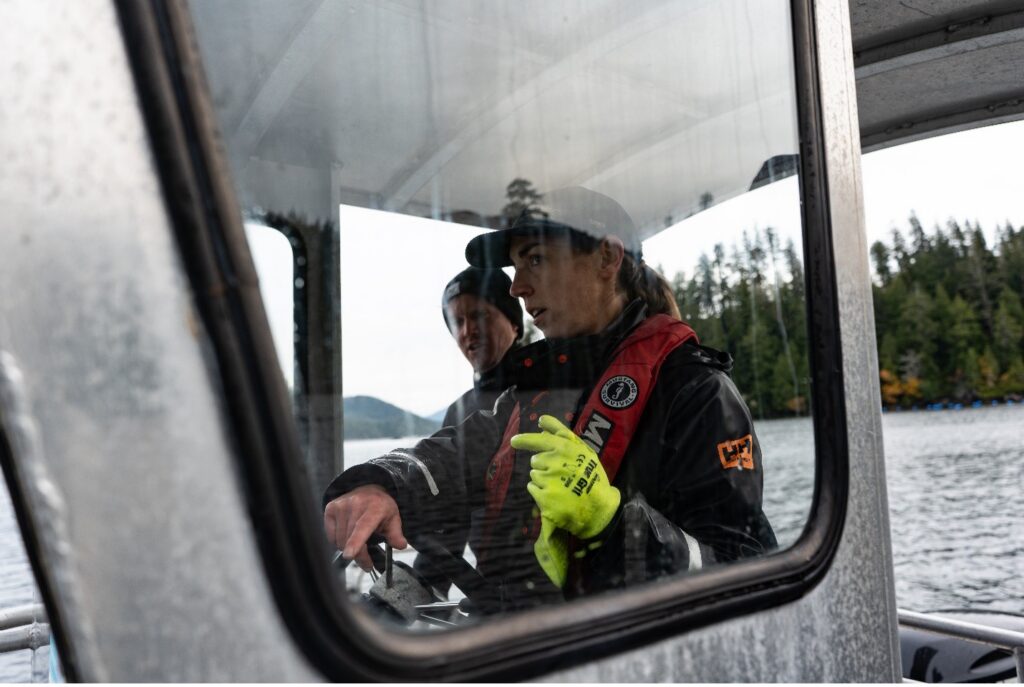
At last, the wind eased, and Rosie was back on the water with the dive team. BMSC skipper Kelly Lavoie and lead diver Brian Timmer ran through the day’s plan: collect kelp samples, retrieve buoys from active restoration sites, and capture 360° underwater footage.
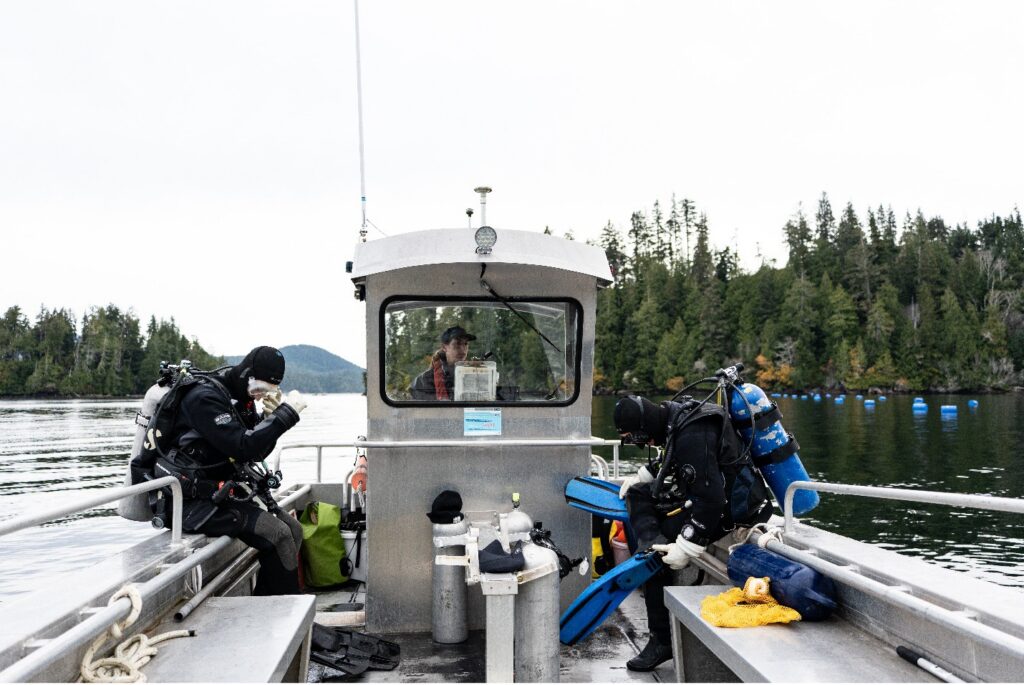
After a 20-minute boat ride to the first site, the divers prepared for a dive, gearing up before back-rolling from the research vessel into the water.
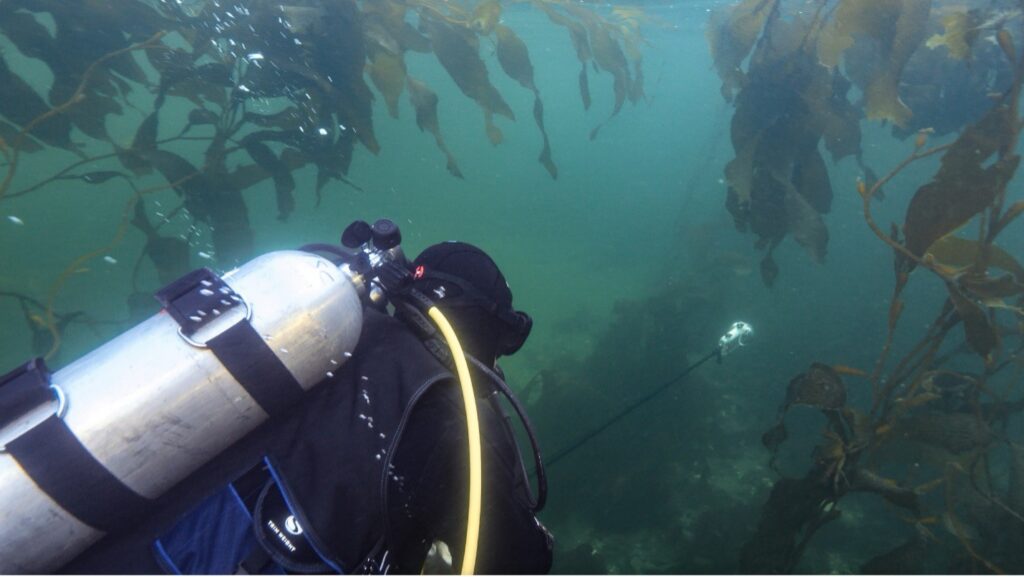
During the last dive of the day, Brian Timmer captured 360° footage of a giant kelp forest. Rosie snorkeled alongside and captured some photos and videos of the researcher at work.
Back to the BMSC dock, field research technician Matt Bakken inspected giant kelp fronds for reproductive spores, the first step in producing new kelp and supporting forest recovery.
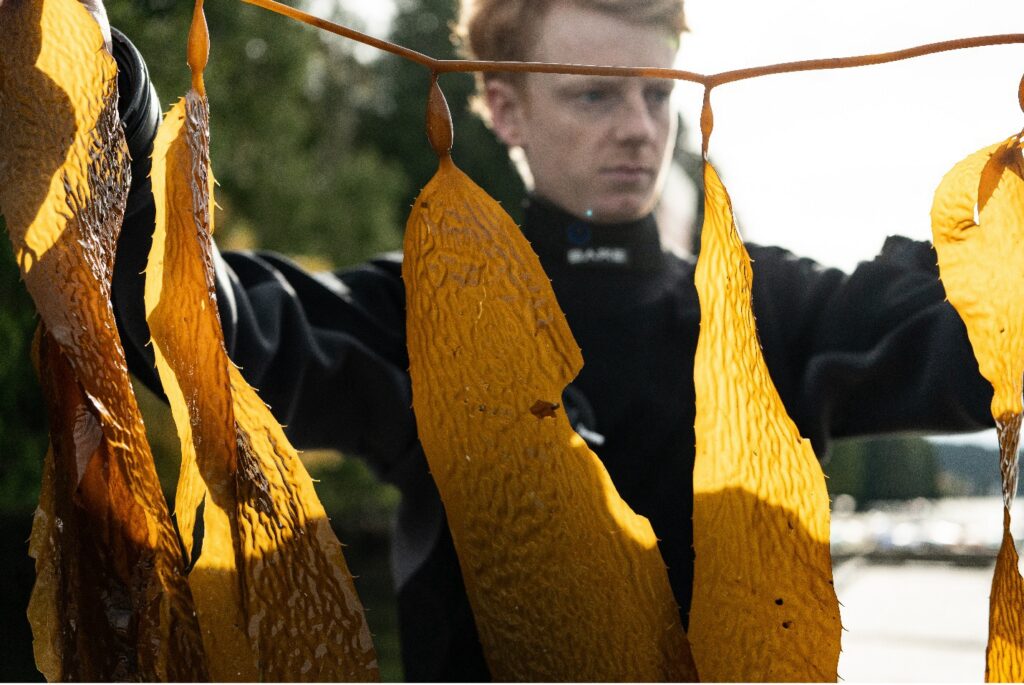
The Kelp Rescue Initiative aims to simplify the technical aspects of the work so they can share that knowledge with coastal communities and First Nations. That way, “if others want to restore kelp forests in their own territories or backyards, they’ll have the tools, knowledge, and resources they need to do it”, explained Brian Timmer, who is also a PhD student at the University of Victoria.
KELP FORESTS: VALUE, IMPORTANCE AND THREATS
• Carbon sink: kelp forests can capture and store significant amounts of carbon -more than 30 million tons of CO2 per year worldwide.
• Economic value: kelp forests provide ecosystem services worth an estimated US$500 billion/year worldwide (fisheries production, nutrient cycling, carbon removal).
• Kelp forest threats: warming oceans, marine heatwaves, changing predator–prey relationships, pollution, coastal development, and other human impacts. The threats vary by region, but climate change is an important common factor.
• Kelp forests can be resilient: Their rapid growth can help them recover from damage, while adaptation, genetic diversity, and healthy ecosystems can improve their resilience. Still, many kelp forests continue to decline worldwide.
SOURCES: Eger et al. 2024, One Earth; Filbee-Dexter et al. 2024, Nature Geoscience; Eger et al. 2023, Nature Communications; Edwards 2025, Annual Review of Ecology, Evolution, and Systematics
Bringing the kelp forest experience to the public
Using the divers’ stunning video footage, MEOPAR awardee Jasmin Schuster created high-quality 360° underwater videos showcasing healthy kelp forests, sea urchin barrens, and kelp restoration sites. She then brought this immersive experience to the public through virtual reality headsets, allowing people to experience the sensation of diving through a kelp forest.
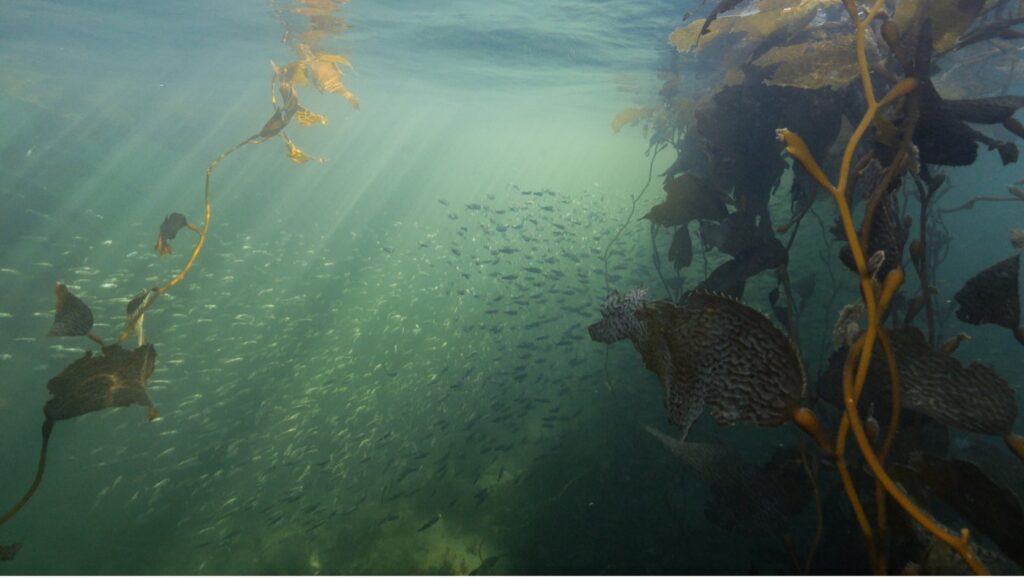
Juvenile herring swim through giant kelp forest at one of the survey sites near the Bamfield Marine Sciences Centre.
The project reached over 1,250 people through more than 30 knowledge mobilization events and workshops across Vancouver Island. “The kids loved the VR [virtual reality] experience. The room was full of giggles and excitement. […] [It helped] the kids get to know the underwater environment on their doorstep that many aren’t able to experience”, said Ryan Salter of the Association for Denman Island Marine Stewardship. VR dives were also offered to Indigenous Elders, providing an opportunity to reconnect with the submerged landscapes of their traditional territories.
“Knowledge mobilization is really important because as scientists, we’re constantly asking questions, figuring out solutions, but then we [mostly] keep that internally”, explained Brian Timmer. “If we’re not actually sharing those solutions with the broader public […], then what’s the point of doing all that science?”, questioned Brian, who recently attended his First Nation’s Land and Water Day, where youth and Elders virtually explored kelp forests using the headsets.
Tired but full of wonderful memories and compelling footage, Rosie hit the road back, ready to share this inspiring story with the MEOPAR community.
BONUS READ – Uniting efforts to protect kelp forests across Canada
As part of its Community of Practice (CoP) Program, MEOPAR is funding the National Kelp Ecosystem Learning and Practice Alliance (NKELPA) CoP for 2025–2028. Led by Margot Hessing-Lewis of the Bamfield Marine Sciences Centre and Aaron Eger of the Kelp Forest Alliance, the network also counts Brian Timmer among its members.
“Canada never really had a shared picture of what kelp looked like across the [country’s three] coasts. The Pacific was doing a really good job, and the same was true for the Arctic and Atlantic. But people working across all three coasts weren’t really speaking to one another in a way that could advance kelp conservation on a national scale”, explained Hannah Solway, the coordinator of the NKELPA CoP.
“Through this community of practice, we’ve been able to connect the Arctic, Atlantic, and Pacific. People working on kelp are meeting for the first time and sharing methods, research, and the latest articles and findings from their work. It’s creating space for new ideas and collaborations to grow,” affirmed the CoP coordinator.
MEOPAR also supports several other kelp-related projects, whose leads joined the NKELPA CoP. Stay tuned for more stories on kelp research, restoration, and outreach!
MEOPAR funded projects on kelp• Virtual Kelp Forests: Immersive Virtual Journeys that Inspire Inclusive Responsibilities for Coastal Transformation and Sustainability (KMF 2025-2026, led by Jasmin Shuster, Kelp Rescue Initiative)
• National Kelp Ecosystem Learning and Practice Alliance (NKELPA) CoP (CoP 2025-2028; led by Margot Hessing-Lewis from the Bamfield Marine Sciences Centre, Aaron Eger, Kelp Forest Alliance)
• ƛaʔuukʷiʔatḥ Kelp Forest Documentary (KMF 2026-2027; led by Mandala Smulders, Redd Fish Restoration Society)
• Kelp gardening: Co-designing research to support climate-resilient kelp forests by bridging Indigenous and western science (Community-led Research Seed Fund 2026-2027; led by Anne Salomon, Simon Fraser University and Káníɫkás Desiree Lawson, Haíɫzaqv Climate Action)
• A Decentralized Biobanking Framework to Enable Red Seaweed (Pyropia) and Sugar Kelp (Saccharina latissima) Conservation and Cultivation in British Columbia (ECR 2026-2028; led by Logan Zeinert, North Island College)
Want the latest research and data on the health of kelp forests worldwide? Check out the 2026 State of the World’s Kelp Forests Report by the Kelp Forest Alliance.