On the precedent-setting expedition of a Canadian naval vessel into Antarctic waters, a cross-country collaborative research effort furthered Canada’s scientific understanding of polar waters and climate
Within days of completing her PhD at the University of Victoria, chemical oceanographer, Dr. Tia Anderlini, joined the team of Canadian scientists aboard the Canadian Naval vessel, HMCS Margaret Brooke, to conduct first-of-its-kind research in the Antarctic. The findings from the March 2025 expedition will be a huge step to furthering Canadian understanding of polar waters and climate change.
Dr. Anderlini’s research focuses on the distribution, sources and transport of trace metals such as iron, manganese, cadmium, and lead in Canadian coastal waters. Trace metals can act as either essential micronutrients or harmful toxins, significantly impacting marine ecosystems and the communities that rely on them.
During this groundbreaking expedition, Dr. Anderlini’s goal was to investigate how regional warming affects the mobility of trace metals in coastal zones, particularly in relation to glacial melt and coastal erosion.
“Wasting of tidewater glaciers and coastal erosion may be an important source of trace metals from the South Shetland Islands to the Southern Ocean, with implications for biological productivity,” Dr. Anderlini explained.
Obtaining the samples necessary to complete this research is challenging, especially aboard a large metal ship like The Margaret Brooke, and specialized equipment was necessary for Dr. Anderlini to conduct her field work.
The research team onboard The Margaret Brooke brought together scientists from universities across Canada – University of Calgary, Dalhousie University, University of Quebec, Université de Sherbrooke, University of New Brunswick, University of Victoria, and will even bring back samples to a lab at the University of Ottawa– as well as scientists from three government departments – Environment and Climate Change Canada (ECCC), Natural Resources Canada (NRCan), and Fisheries and Oceans Canada / Pêches et Océans Canada(DFO).
The Marine Environmental Observation, Prediction and Response Network (MEOPAR) coordinated the national academic delegation and provided essential research equipment alongside NRCan and DFO.
Having previously completed similar work in the Canadian Arctic Archipelago and Baffin Bay, Dr. Anderlini was uniquely positioned to draw comparisons between the two polar regions to aid in the overall understanding of trace metal distributions and ocean productivity.
Working with Dr. Jay Cullenout of the University of Victoria, whose research lab currently focuses on understanding how ongoing and rapid climate change is impacting the marine system in the Canadian Arctic, Dr. Anderlini’s research on the expedition can offer important insights to add to their findings.
“The opportunity to study coastal Antarctic systems, which are also experiencing rapid warming and ongoing change, on the HMCS Margaret Brooke, allows us a southern hemisphere analog to compare and contrast with our Arctic Ocean,” said Dr. Cullen.
Testing for trace metals is precise work and Dr. Anderlini had to conduct her research carefully during the expedition. She explains her process in her own words:
“While sampling at sea we work within a “clean-lab bubble” – an enclosure made of plastic drop sheets and filled continuously with HEPA-filtered air from a laminar flow hood.”
“Seawater samples are collected from Teflon-lined GO-FLO water samplers which are secured on a synthetic Kevlar line and closed at our desired water depths by weighted Teflon-messengers.”
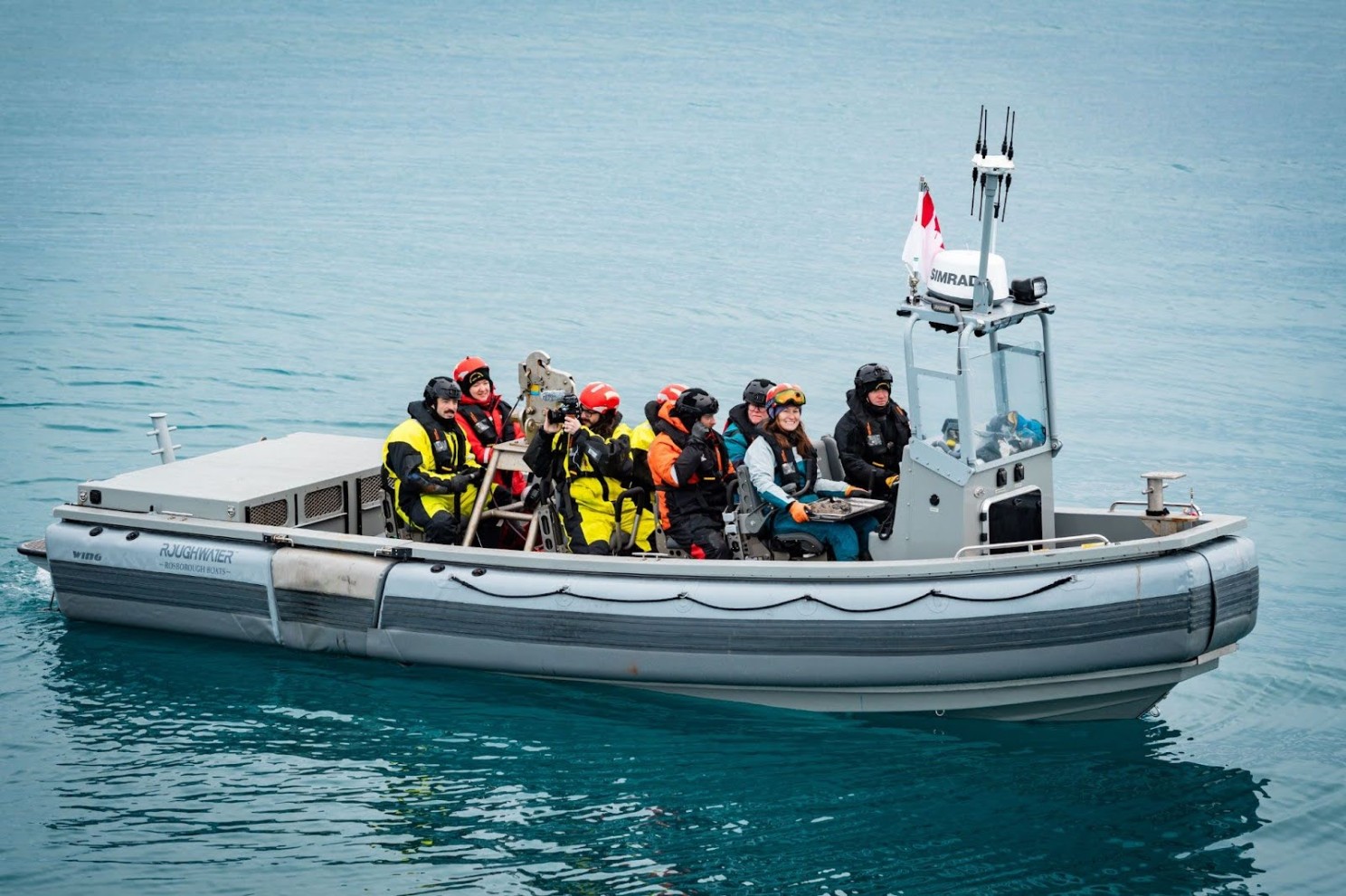
“My work in the Antarctic has required the use of Multi-Role Rescue Boats (MRRBs) in order to get as near to glacier fronts as safely possible. From the MRRB I sample from the GO-FLO water samplers at various depths, and collect a surface sample from a plastic 6.5 m pole sampler. This avoids collecting water which has been contaminated by the MRRB itself.”
These samples will be studied back at the University of Victoria, where Dr. Anderlini and Dr. Cullen can work to assess their findings and gain a greater understanding of the role trace metals play in polar marine ecosystems.
To learn more about the Canadian academic delegation, as well as the important research that came out of the Antarctic expedition, follow MEOPAR: Marine Environmental Observation, Prediction and Response Networkon LinkedIn.